
In modern exterior and semi-open architectural design, screens, louvers, and partitions play a key role in balancing privacy, ventilation, and visual appeal. Material choice and profile size directly influence how these elements perform.
Narrow WPC planks are increasingly used in such applications due to their ability to create controlled spacing, consistent alignment, and clean linear aesthetics. This guide explains how slim-profile planks contribute to both functional and design outcomes in these structures.
How do narrow plank profiles influence visual proportion?
The width of a plank significantly affects how a structure is perceived.
Narrow planks help achieve:
- finer detailing in façade elements
- balanced proportions in vertical and horizontal layouts
- a more refined and contemporary appearance
In screens and partitions, wider planks can make the structure look heavy, while narrow profiles create a lighter, more architectural finish.
Why are narrow planks suitable for louvers and screens?
Louvers and screens rely on spacing and repetition to function effectively.
Narrow WPC planks allow for:
- precise spacing between elements
- better control over light filtration
- improved airflow through structured gaps
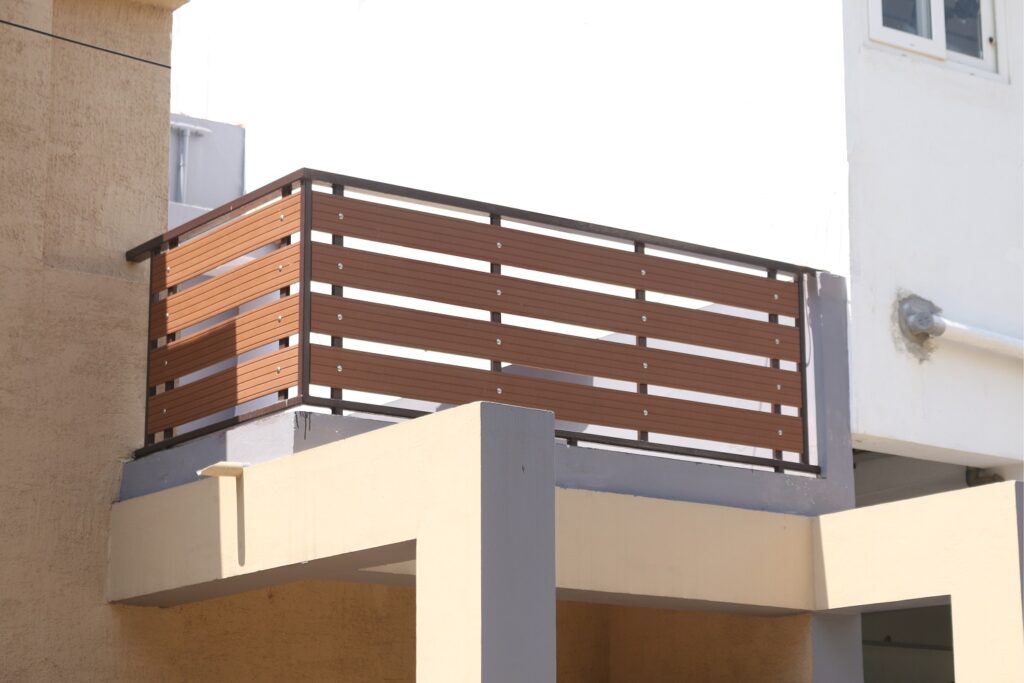
This makes them suitable for applications where both ventilation and shading are required, such as façade screens and balcony partitions.
Explore how these applications are used in real projects on the WPC Planks Applications page (Louvers & Screens section).
How does spacing impact performance in partitions and screens?
Spacing between planks determines how the structure performs in real-world conditions.
Correct spacing helps:
- regulate visibility and privacy
- allow airflow without compromising structure
- maintain uniformity across the installation
Improper spacing can lead to either excessive openness or restricted airflow, affecting both usability and design intent.
What role does alignment play in design consistency?
Consistency in alignment is critical in applications like screens and partitions, where repetition defines the visual outcome.
Narrow planks support:
- uniform alignment across large surfaces
- clean linear patterns
- reduced visual distortion in extended installations
This is especially important in façade elements where even minor misalignment becomes noticeable.
How do narrow WPC planks perform in exterior conditions?
Exterior applications require materials that can maintain stability under changing environmental conditions.
In screens and louvers, narrow planks must:
- retain alignment despite temperature changes
- resist moisture exposure
- maintain surface finish over time
Proper installation and spacing ensure that the structure continues to perform without affecting its visual appearance.
Where are narrow WPC planks commonly used?
Slim-profile WPC planks are widely used in:
- façade screens
- sun-breaker louvers
- balcony and terrace partitions
- garden dividers and semi-open enclosures
These applications benefit from the ability to combine structure with design flexibility. See how different applications like partitions, louvers, and cladding are structured on the WPC Planks Applications page.
How do narrow planks support design flexibility?
Narrow profiles allow architects and designers to experiment with:
- vertical or horizontal orientations
- varying spacing patterns
- layered or staggered designs
This flexibility makes them suitable for both functional partitions and decorative architectural elements.
Conclusion
Narrow WPC planks play an important role in modern architectural applications where design precision and functional performance must work together. Their ability to control spacing, maintain alignment, and support clean visual patterns makes them ideal for screens, louvers, and partitions. When used thoughtfully, they enable structures that balance privacy, airflow, and aesthetics in exterior and semi-open spaces.
Frequently Answered questions
Q1: Where are narrow WPC planks typically used?
Narrow WPC planks are commonly used for screens, louvers, partitions, and façade elements where controlled visibility, airflow, and design flexibility are required.
Q2: Are narrow WPC planks suitable for outdoor applications?
Yes, narrow WPC planks are designed for exterior use and perform well in conditions involving moisture, sunlight, and temperature variations.
Q3: Why choose narrow planks for louvers and partitions?
Narrow planks allow better spacing control, visual rhythm, and airflow, making them suitable for applications that require both aesthetics and functionality.